Mar 14 2010

Virtualising my Laptop

Category: Hardware, Linux, WindowsTeknovis @ 2:41 pm

I want to buy a new laptop for myself. I need it! My old one is too big and heavy, the screen is losing its contrast, and the battery lasts for approximately 30 seconds :(

In the past I tended to buy high-end laptops on the basis that they would last for longer. This worked to a certain extent, but this time I want to try a new approach. I am going to buy a relatively low-end laptop, but replace it more frequently. The disadvantage of this approach is that it is very time consuming to setup a new computer.

Last year I started experimenting with using Ubuntu within VMware as my main desktop operating system on and old computer. I was very impressed with its speed and stability. So I have decided that I am going to virtualise my entire desktop on the new laptop. The advantages of this approach are:

  • Moving my computer from one piece of hardware to another becomes trivial. This is useful for when I want to upgrade my laptop in the future. It also means that I can put my computer onto an external hard disk.
  • Backing-up my computer also becomes trivial. I am thinking about backing it up automatically every night!
  • Snapshots can be taken before I install any software on a test basis. I can then roll-back my computer if I do not like the new software.
  • It provides my computer with a lot of extra security from network based attacks.

My overall requirements for my new laptop are that it supports three different virtual machines:

  • I want to start using the Ubuntu based virtual machine as my main computer. I am waiting for Lucid Lynx 10.4 LTS.
  • I am currently using Windows 2000 as main my operating system. I think it is great ;)
  • Unfortunately, I have one program that I need to use regularly, and this program requires Windows XP (or later) :(

I will use NAT to network all three virtual machines most of the time. However, sometimes I will need to use the Windows 2000 virtual machine in bridged mode so that it can be a first class member of my domain.

Therefore, the overall architecture of what I am trying to achieve should look like this:
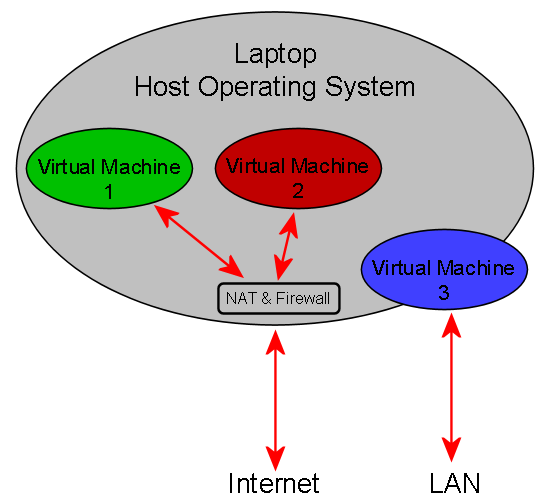
Laptop Virtual Architecture

Laptop Virtual Architecture

Now that I know what I want to achieve, I just need to find the best way to realise this!

Hardware

I am currently considering buying either a Dell Inspiron 1545Inspiron 15 Intel Core i, or a Studio 15. I am a Dell fan, and a 15″ screen is the best size for me. I will get 4GB of RAM, and either a 350GB or a 500GB hard disk.

I will get one of the cheapest processors available. I am currently considering either the Intel Pentium Dual-Core Processor T4400 or the Intel Core i3-330M. I will probably choose the latter, because it seems to have better support for virtualisation because it supports VT-x according to its specification. In practice I do not know if this will provide a noticeable benefit.

In terms of form-factor, I dislike the idea of a number keypad on a laptop. Therefore, I will probably go for a Studio 15.

I am going to have to buy an external card reader, because none of these laptops support Compact Flash cards :( My cameras all use Compact Flash :o

I wonder how the host operating systems sees the integrated web camera. I hope that it appears as a standard USB device, so that it can easily be shared with the virtual machines.

Host Operating System

My requirements for the host operating system are:

  • It must be very secure, because I will use my laptop in a lot of public networks.
  • It must be easy to connect to file servers. This is important, because I will need to back-up my virtual machines.
  • It must have a software based firewall that is very easy to configure precisely.

I think that the clear winner here is Ubuntu with Firestarter. If my Linux skills were better I would use Debian instead :o

The only question I have is whether I should use the 32bit or the 64bit version of Ubuntu?

Virtual Machine Software

The two options that I am considering for this are VMware Workstation and VirtualBox. My main requirements are that the virtual machine software is secure, and that it supports VT-x. I think that both do!

However, there are still some issues that I have not resolved:

  • Should I use the 32bit version or the 64bit version?
  • Which offers better performance?
  • Will they both support my hardware equally well?
  • Is there a risk of becoming locked into one of these products?
  • How is Hyper-threading supported? Presumably, the virtual machine software would think that it has four cores to distribute to the virtual machines. However, in reality it would only have two. This makes me think that I should disable Hyper-threading.
  • Does the virtual machine file format change with each new release of the virtual machine software?

Cost is not really an issue here.

Guest Operating Systems

As I wrote above, I will use Ubuntu, Windows 2000, and Windows XP on my virtual machines.

My questions relating to the guest operating systems are:

  • Should I choose the 32bit or the 64bit version of Ubuntu?
  • Will the OEM version of Windows XP that I got with a previous Dell computer install into a virtual machine without lots of registration issues?

If anybody has any opinions, experience, advice, or answers relating to any of this then I would love to read them!

Thanks!

Tags: , , , , , , , , ,


Jul 17 2009

A Frustrating End

Category: WindowsTeknovis @ 4:33 pm

I have recently been trying to use the Home and End buttons regularly when I am viewing large documents within Windows. However, it has been a bit frustrating, because their behaviour seems to vary depending on the application that I am using them within :(

For example, they pan to the beginning or end of a document within Firefox.  Whereas in Notepad++ they move the cursor to the beginning or end of the current line.

:(

Tags: ,


Jul 13 2009

Default Windows XP Wallpaper

Category: WindowsTeknovis @ 11:02 pm

I came across the story behind the default Windows XP wallpaper, known as Bliss, on Wikipedia tonight. The article, Bliss, shows the original wallpaper, and a more recent photo! There is a huge difference!

Tags: ,


Jul 01 2009

Firefox Default Browser

Category: WindowsTeknovis @ 7:28 pm

The other issue (besides Removing Windows Media Player Icons) that I spent a lot of time trying to resolve over the weekend was setting Firefox as my default browser!

I have several Windows 2000 Workstation computers that are setup identically, and I use roaming profiles so that I only need to maintain a single profile. Firefox is configured as my default browser, and the option to Always check to see if Firefox is the default browser on startup is enabled (see Default browser).

Everything worked perfectly, except on one computer! This troublesome computer would always ask me if I wanted to make Firefox my default browser the first time that I ran it in a single login session! This made me think that the problem must be somewhere in the Registry under HKEY_CLASSES_ROOT. However, I could not understand why I was only prompted the first time I ran Firefox.

I eventually found a very explanatory article called How Does Your Browser Know that It’s Not The Default? that describes how Firefox associates itself with protocols and file types. I could see the values of the relevant keys in HKEY_CLASSES_ROOT changing when I ran Firefox. I was surprised that these values could be changed using a normal user account!

The thing that I did not know until I read the article was that HKEY_CLASSES_ROOT is actually created dynamically when the user logs in by merging the computer’s settings in HKEY_LOCAL_MACHINE\Software\Classes and the user’s settings in HKEY_CURRENT_USER\Software\Classes. This is described in more detail in HKEY_CLASSES_ROOT Key.  So Firefox was not configured as the default browser in HKEY_LOCAL_MACHINE\Software\Classes.

Ultimately, the solution was very easy :o I used the Add/Remove Programs setting in the Control Panel of the Administrator account as described in Setting default browser manually.

Tags: ,


Jun 29 2009

Removing Windows Media Player Icons

Category: WindowsTeknovis @ 7:21 pm

I spent a lot of time over the weekend trying to resolve some very small, but very annoying, issues with my home computers. After many hours I resolved my issues, so I will document them here!

First let my briefly describe my setup. I have a Windows 2000 Server that I also log into locally to use as a workstation. I also have several Windows 2000 Workstations (some are desktops and some are laptops). All of these computers are setup identically, and I use roaming profiles to minimise my administration! It all works very well!

However, something that really annoyed me was that if I logged in and out of a workstation, and I subsequently logged in locally to the server, I would have Windows Media Player icons added to my desktop and my start menu. So what was causing these icons to constantly reappear?

The first thing I checked was the Add/Remove Programs setting in the Control Panel of each computer. These were not configured to show any icons on my desktops.

Next I checked to see if there was something in my Startup folder. Specifically, I checked the following two locations:

  • C:\Documents and Settings\Teknovis\Start Menu\Programs\Startup
  • C:\Documents and Settings\All Users\Start Menu\Programs\Startup

There was nothing unusual there, so next I checked the Registry. Usual disclaimer: Do not manipulate the Registry unless you are certain of what you are doing! In this case the following locations need to be checked:

  • HKEY_CURRENT_USER\Software\Microsoft\Windows\CurrentVersion\Run
  • HKEY_CURRENT_USER\Software\Microsoft\Windows\CurrentVersion\Runonce
  • HKEY_LOCAL_MACHINE\SOFTWARE\Microsoft\Windows\CurrentVersion\Run
  • HKEY_LOCAL_MACHINE\SOFTWARE\Microsoft\Windows\CurrentVersion\Runonce

There was nothing unusual in these either :(

In fairness, all of that was the easy part, and I did not expect it to yield any useful results. I thought it must be significant that the icons only reappeared when I logged in locally to the server. I searched the Internet extensively, but I could not find any solutions :(

So next I started searching for information about other Registry locations that cause applications to be executed when a user logs in to the computer. I found two such locations:

  • HKEY_CURRENT_USER\Software\Microsoft\Active Setup\Installed Components
  • HKEY_LOCAL_MACHINE\SOFTWARE\Microsoft\Active Setup\Installed Components

Windows compares the contents of both of these to determine if it needs to install any additional software when a user logs in. This is described in detail in Active Setup and how to implement it and Active Setup and how to implement it. I then looked for references to Windows Media Player. The location HKEY_LOCAL_MACHINE\SOFTWARE\Microsoft\Active Setup\Installed Components\>{22d6f312-b0f6-11d0-94ab-0080c74c7e95} caught my attention!

On my workstation it contained the following keys and values:

  • ComponentID="Windows Media Player"
  • Locale="*"
  • DontAsk=dword:00000002
  • Version="9,0,0,2980"
  • IsInstalled=dword:00000001
  • Stubpath="C:\WINNT\inf\unregmp2.exe /HideWMP"

On my server it contained the following keys and values:

  • DontAsk=dword:00000002
  • Version="9,0,0,2980"
  • IsInstalled=dword:00000000
  • Stubpath="C:\WINNT\inf\unregmp2.exe /ShowWMP"

So it was the last key and value that were causing my icons to reappear! I finally found the cause of the problem!

There are numerous solutions to resolve this, and some of these are described in the documents referenced above. However, the option I chose was to change the value of the IsInstalled key to dword:00000001. I can confirm that this solution works :)

Tags:


Jun 26 2009

Notepad++ Missing Toolbar

Category: WindowsTeknovis @ 5:11 pm

I read a claim recently that most people’s favourite text editor is the first one that they ever used. In my case this is certainly not true, and I have tried several. My favourite Windows text editor for the past few years has been Notepad++.

I upgraded my old and outdated version to the latest versions (5.4.3) today. I am very happy with the improvements that I have noticed, but I also found one big bug - the main toolbar is missing! I have tried changing the preferences, and I tried installing customised tool bar icons (as described in Change Theme HOWTO). Neither of these had any effect :(

I have since discovered that this is a known issue, as described in Missing Toolbar in 5.4.3. It will be fixed in the next version, but until then I am going to use version 5.4.2.

Tags:


Jun 23 2009

Annoying Adobe Acrobat Toolbar

Category: WindowsTeknovis @ 7:24 pm

This great tip describes how to remove the really annoying Adobe Acrobat toolbar from Microsoft Office: Removing and Reinstalling Acrobat PDFMaker (6.0 for Office 2000 or XP).

Tags: ,


Jun 23 2009

Firefox Printing to Adobe PDF Writer

Category: WindowsTeknovis @ 6:52 pm

I noticed recently that any time I tried to create a PDF file from Firefox using my Adobe Acrobat PDF Writer the resulting PDF file was unreadable because the fonts were illegible :(

I had some time this evening to look into this problem, it it seems that it is a known issue with older versions of Adobe PDF Writer: Font glyphs incorrectly displayed with certain printer drivers.

Maybe I should look into an alternative PDF Printer, because I hate the way that Acrobat embeds itself so much into my operating system!

Tags: ,


May 18 2009

Patched Windows 2000 Installations

Category: WindowsTeknovis @ 8:19 am

I had to install Windows 2000 on some computers over the weekend. The last time that I installed this operating system was several years ago! My main concern was figuring out what service packs and hot fixes needed to be installed. This is what I installed:

  1. Windows 2000 (from original CD)
  2. Service Pack 4 (W2KSP4_EN.EXE - 129MB)
  3. Rollup 1 for Windows 2000 SP4 (KB891861) (Windows2000-KB891861-v2-x86-ENU.EXE - 31MB)
  4. Conficker Protection MS08-067 (KB958644) (Windows2000-KB958644-x86-ENU.EXE - 1MB)

These computers are operating on an isolated network that does not have Internet access. However, other laptops are regularly attached to the network.

Tags: ,


Jan 08 2009

Windows 2000 Alive and Well

Category: WindowsTeknovis @ 9:22 am

I previously wrote about the demise of Windows 3.11 in Goodbye Windows 3.11!. I have not used in it many years, so this news did not concern me.

However, I still regularly use Windows 2000 because it does everything that I need. It also gives much better performance on older computers than its successor Windows XP.

I have been thinking recently about how popular Windows 2000 remains. I started thinking about this after reading an article describing how the UK’s Royal Navy has started using a mix of Windows 2000 and Windows XP on its nuclear powered submarines. This is instead of the traditional custom designed software. The full article is Royal Navy completes Windows for Submarines™ rollout.

During the Christmas holidays I was in several airports, and I was in many department stores. I was really surprised to see that many of the computers in these locations (boarding gates and customer information desks) were using Windows 2000. It is easy to spot this when the computers are not being used, because both the login screen and the default screensaver of Windows 2000 are distinctive.

It must be the case that the benefits of using the newer operating systems do not yet justify the massive additional costs of upgrading so many computers.

Tags: , , ,


Next Page »