The BBC asks if the US one cent coin should be abandoned in The US penny: Should it be scrapped?.
It also provides the following nice infographic:

US One Cent Coin Infographic (Copyright BBC)
It is an interesting question, and I do not have a strong opinion on it either way.
However, I would not like the Euro cent to be discontinued!
Tags: BBC
Comments Off on The End of the US Cent Coin?
I read an article yesterday claiming that tablet users consume more online news. See Tablets Drive Deeper News Consumption [STUDY].
Yes – I am definitely one of those people!
The thing that really annoys me about certain news websites (RTE, The Irish Times, BBC) is that their RSS feeds only contain the first line of the news story, and then I have to browse a very heavy desktop page to read the rest of the story. I wish that they would provide either a full feed, or a second feed with the full articles!
Tags: BBC, RTE, The Irish Times
Comments Off on Tablet (Computers) and Online News
Today RTE launched its on-demand video player, which is unimaginatively called RTÉ Player. I have not had a chance to try it yet, but I already watch a lot of RTE current affairs content on demand. Perhaps my biggest misgiving about the new player is the fact that it is browser based, rather than utilising a separate standalone application.
For more details about this story see RTÉ launches catch-up TV service.
The BBC launched a similar on-demand video player over a year ago called the iPlayer. This caused excessive network usage at that time for BT, and this resulted in extra charges to end-users. This highlighted the increasing problems in the relationship between content producer and content distributor. Ultimately, they will both need to work together! To read more about this see Jaw Jaw, Not War, War.
The next logical step in the roll-out of IP based video on-demand is to supply end-users with set-top boxes. Indeed, this is already being considered for the iPlayer according to BBC, ITV and BT plan to bring iPlayer-style services to TVs. I wonder will RTE do this also!
Tags: BBC, BT, RTE
Comments Off on RTE Launches On-Demand TV Player
I read an interesting article on the BBC News web site last weekend, and today I wanted to email its link to a friend. Unfortunately the link was no longer present on the homepage, so I used the search facility. This was a very frustrating experience, partly because I could not remember the title of the article. So after about 20 minutes I gave up :(
This made me think that it is a pity that the BBC News web site does not have a calender function to search the archive. For example, the RTE News web site contains such a calender.
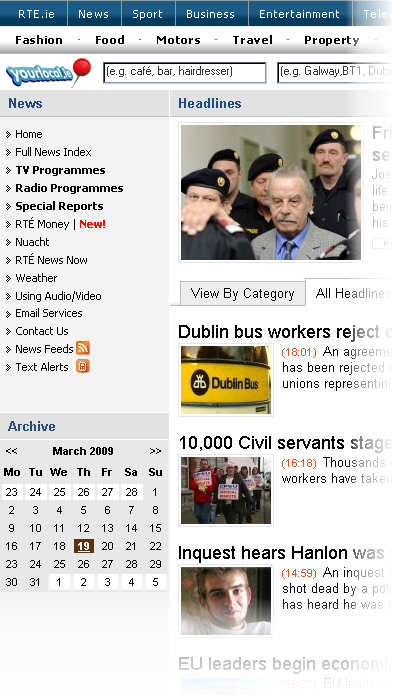
RTE News Archive Calender
After a quick search on the Internet I realised that I was not the only person who thought that a calendar function would be useful. Indeed, I found a very nice implementation of such a calendar at BBC News Front Page Archive. It was here that I found the article that I was looking for ;)
Tags: BBC, RTE
Comments Off on BBC News Web Site Archive
The BBC is well known for its in-depth, and meticulous, reporting in articles. It is one of these articles that caught my attention this morning… Indeed, I would go as far as to say it was the most interesting article that I read all week!
The article I am referring to is How do avatars have sex?, and it provides a fascinating insight into how avatars have sex in Second Life! The beginning of the process is:
First you need to buy genitals
I can see why this step is important, but it is not something that I would have thought of before reading the article! Just as in real life, these come in a variety of sizes, shapes, and colours. The article then describes how the new purchase can be used:
You can touch and jiggle about a bit and you can emote and gesture in a way the other person would see
The article then goes on the explain the full process, for those of you who are interested ;)
Wow – I really never expected to be writing about sex on this blog (or indeed any blog)! I wonder if sex will become the most clicked tag in my tag cloud ;)
Tags: Avatar, BBC, Second Life, Sex
Comments Off on Sex Guide for Avatars
The BBC are reporting that Microsoft stopped issuing new licences for Windows 3.11 at the beginning of the month in The end of an era – Windows 3.x. It is really hilarous to consider the hardware requirements for Windows 3.11 now:
- An 8086/8088 processor or better running at 10MHz
- 64KB of RAM
- 7MB of hard drive space
- A graphics card that supported CGA graphics or better
Apparently Qantas and Virgin Atlantic are powering their in-flight entertainment systems using Windows 3.11. I really wonder if they are powering more of their onboard embedded systems using Windows 3.11, and if this would cause people to be more cautious about flying with them!
I have not seen Windows 3.11 in use in a long time, but I do remember it fondly…
Tags: BBC, Microsoft, Qantas, Virgin, Windows 3.11
ComScore released a press release today covering the UK Web Rankings for September 2008. Several news sites are commenting on the fact that Facebook has overtaken the BBC to occupy the fifth spot. Indeed, this was the most significant change in the list. I guess that this is not surprising, given the universal appeal that Facebook currently has!
I find this especially interesting, because I read an article on TechCrunch over the weekend claiming that Facebook may be trying to raise more capital in order to cover their soaring costs. To put this in context, Facebook have raised almost $500 million in 2007 and 2008 already. So what are they doing with all of this cash? Some of the more interesting costs cited are:
- $2 million per week for additional storage
- $1 million per month on electricity
- $500,000 per month on bandwidth
- $10 million per month on payroll
So where are Facebook trying to raise this extra capital from in this time of economic cautiousness? Dubai!
It will be very interesting to see if they succeed in raising more capital, and at what price! I am certainly not dying to get a piece of that action!
Tags: BBC, ComScore, Dubai, Facebook, TechCrunch
Comments Off on Facebook Grows (and Costs Soar)
